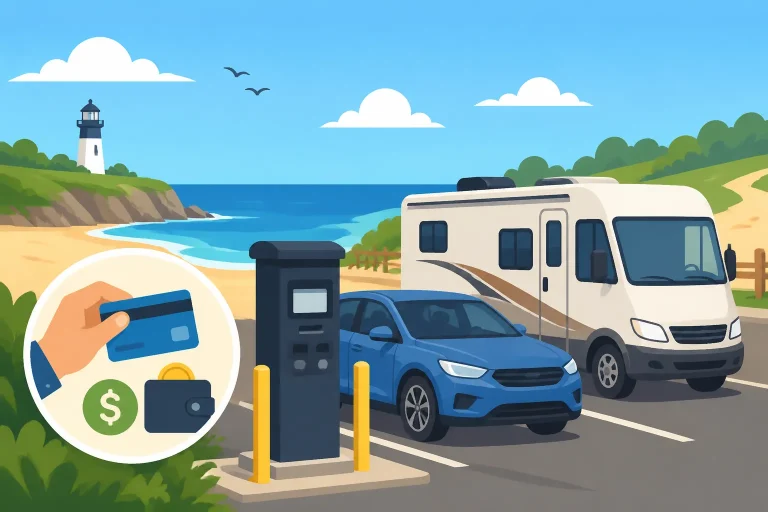
Beach Season Passes: Rhode Island’s Closest Thing to a Park Pass
Planning repeated beach visits in Rhode Island can make parking costs and pass rules hard to compare. A beach season pass may simplify visits, but it is not necessarily a pass for every state park or an answer to every parking question. Here’s how to understand what the pass is meant to cover, evaluate whether it suits your plans, and check current terms before relying on it.
What a Rhode Island beach season pass is—and what it is not
A beach season pass is best understood as a parking product, not a universal state-park admission pass. That distinction matters when planning a trip: parking access at a beach, entry to a park, and a campsite reservation are different things. A pass should be treated as covering only what its current terms say it covers.
The phrase “park pass” can suggest broad access across a whole state park system. Rhode Island’s beach season pass is a closer match for people who repeatedly park at state beaches. It should not be assumed to cover every state park, all parking areas, camping, or additional vehicles. Check the current pass terms for the specific places and uses they include.
That scope is especially important if your plans mix beach days with campground stays. A beach pass is not a substitute for a campsite permit or reservation. It also should not be assumed to provide overnight parking or permission to remain at a beach after its day-use hours. For the differences between lots, campsites, and overnight stays, see Overnight in a Rhode Island State Park: Campgrounds, Lots and Beaches and Is Overnight Parking Ever Allowed at a Rhode Island State Park?.
The pass may be useful if your main expense is parking for repeated beach visits. But whether it saves money depends on the current daily rates, the number of visits you expect, the vehicle category, and the pass’s terms. Those details can change or differ by beach, so an old price or a broad description of the pass is not enough to make a reliable decision.
| Planning question | What to verify |
|---|---|
| Which places are covered? | The current list of beaches, lots, or other locations included |
| Which vehicle qualifies? | The terms for the vehicle you will drive, including a rental or borrowed car |
| Who is treated as a resident? | The current definition and how it is applied |
| What does the pass replace? | Whether it covers parking only or any additional stated use |
| When is it valid? | The season dates and any restrictions in the current terms |
| How do you use it? | The display, plate, or other verification method required by the official system |
If the official description does not answer a question, do not fill in the gap with assumptions from another beach or another season. Confirm the answer through the state’s current official beach parking information before you travel. For related questions about how rates can differ, see Beach Parking Season Passes for Residents and Non-Residents and Which Agency Can Charge for Beach Parking in Rhode Island?.
Why it is Rhode Island’s closest thing to a park pass
The comparison is useful, as long as it stays limited. A beach season pass can make repeated visits to covered state beaches easier to plan because it is organized around seasonal beach parking. That is the part that makes it resemble a park pass. It does not follow that the pass grants general access across all state parks or covers every charge connected to a visit.
A beach visit can involve several separate decisions: where to park, whether that location is covered, what vehicle is arriving, and whether the visit is for day use or an overnight stay. A pass can help with one part of that plan without answering the others. Treat it as a specific tool for a specific purpose, then verify whether that purpose matches your itinerary.
This is also why the name alone is not enough. “Season pass” tells you that the product is tied to a season, but does not by itself establish the season’s dates, every covered beach, how many vehicles it applies to, or whether a pass can be shared. Those are terms to confirm rather than infer.
If you are considering a pass because you want to visit different places around Rhode Island, make a list of the locations you actually expect to use. Check each one against the current coverage information. If one location is not listed, do not assume that a pass valid at another beach works there too. The same caution applies to a state park that has a beach: the beach parking terms and other park uses may not be identical.
Visitors sometimes use “entry,” “parking,” and “access” interchangeably, but they can mean different things in practice. A pass described as a beach parking pass should be assessed as a parking pass unless its current official terms say more. For broader context about the system, Beaches, Campgrounds and Cabins: Rhode Island’s State Park System explains how different kinds of state recreation sites fit together. State Beaches vs State Parks in Rhode Island: Fees and Hours Compared is also relevant when deciding whether a beach-focused product matches a park-focused outing.
A useful way to prevent misunderstandings is to write down what you expect the pass to do. For example: “I want to park at the covered state beaches I plan to visit.” That is more precise than “I want a park pass.” Then compare that expectation with the official description. If the terms support the narrower purpose, the pass may be a fit. If you need overnight access, campground use, or entry to locations not listed, you will need to check those separately.
Resident and non-resident prices: why old figures need context
Online searches can turn up old regulations and past pass listings. They are useful for understanding that resident and non-resident vehicles have been listed separately, but they are not a reliable substitute for current terms.
According to the Rhode Island Department of State, the inactive regulation lists a resident beach parking season pass at $ 30.00 per vehicle (as of November 2026). Because that regulation is inactive, this figure should not be treated as a confirmed current price.
The Rhode Island Department of State’s 2022–2023 beach parking season pass listing states: Non-Resident PER VEHICLE $ 60.00. This is a past listing, not confirmation of a current charge. Check the current official information before budgeting or purchasing.
Those historical listings show why it is important to check both residency category and date. A past resident figure cannot establish a current resident rate, and an old non-resident listing cannot establish what a visitor should expect to pay now. Even if a price appears in a regulation or an archived pass description, its status and effective terms matter.
Do not assume your mailing address alone determines which category applies. The current terms may define residency or explain how vehicle eligibility is established. Follow the official wording for the specific pass you are considering. If the vehicle is registered out of state, rented, borrowed, or newly registered in Rhode Island, look for guidance that addresses that situation rather than relying on a general assumption. Related articles include Resident Beach Rates Follow Your Car’s Plates, Not Your Address, Rental Car With Out-of-State Plates at a Rhode Island State Beach, and New to Rhode Island? When Your Car Counts as a Resident Vehicle.
When checking a price, make sure you are looking at the right product. A daily parking rate, a season pass, a fee for a particular beach, and an archived regulation may appear in similar search results but describe different things. Also check whether the displayed amount is for a vehicle, a person, or another unit. A pass listed per vehicle should not be compared casually with a daily charge that is described differently.
If a page does not clearly state whether it is current, look for the current official beach parking information and use that as the basis for planning. If you cannot tell whether an old rule or listing has been replaced, do not treat the old figure as a promise that it will be accepted. For more help sorting through dated pages, see Old Park Fee Tables Online: Why Rhode Island’s Are Out of Date and Where Rhode Island Park Fees Are Posted Since the Old Rule’s Repeal.
How to decide whether a season pass is worth considering
The basic comparison is between the total cost of the visits you expect to make and the current cost and terms of the pass. You do not need to guess at a break-even point using an outdated price. Instead, collect the current figures and use your realistic plans.
Start with the beaches you are likely to visit. Count planned visits, not every beach day you might take if conditions are perfect. A pass is less useful if most of your trips are uncertain, if you tend to visit locations that are not covered, or if your plans depend on a vehicle that does not meet the pass terms. If the current information lists several covered beaches, compare that list with where you actually want to go.
Next, find the current daily parking cost for the relevant beach or beaches and the current season-pass price for your vehicle category. Make sure the comparison uses the same basis. A resident pass should not be compared with a non-resident daily rate, for instance, unless those are genuinely the categories that apply to your situation. Check whether additional terms affect how you would use the pass.
Then estimate the parking cost of your expected visits if you paid day by day. Compare that estimate with the pass cost, while accounting for visits to places that may not be covered. If you would still need to pay separately for some destinations, include those costs in the day-by-day alternative. The result is only as useful as the assumptions behind it, so keep the estimate tied to confirmed current rates and your likely itinerary.
| If your plans look like this | What to weigh |
|---|---|
| Several visits to beaches listed as covered | Compare expected daily parking costs with the current pass terms |
| A small number of likely visits | Check whether paying per visit better fits your plans |
| Trips to a mix of covered and unlisted locations | Include separate parking costs for locations not covered |
| A rental or borrowed vehicle | Confirm that the vehicle and its registration meet the pass terms |
| Beach days plus camping | Evaluate the beach pass and campsite costs as separate items |
| Plans that depend on a particular date | Confirm the beach’s operating details and parking information before leaving |
The calculation is not only about price. Consider how the pass is issued and used. If the official terms require a particular vehicle, plate, display method, or proof of eligibility, make sure your trip plan meets those requirements. If several people in your household use different cars, do not assume one pass can move freely between them. Check the current rules for sharing or changing vehicles. Sharing a Beach Season Pass Between Family Cars and Which Vehicles a Rhode Island Season Beach Pass Covers address those questions.
A pass may also be less convenient than paying per visit if your travel plans change often. Weather, availability, or personal schedules can affect how many times you go. Avoid treating a hopeful estimate as a guarantee of savings. If the pass is not refundable or has restrictions, those terms should be part of your decision; confirm them before purchase rather than assuming what happens if you cannot use it.
Finally, compare like with like. Do not mix a pass intended for one season with an estimate that includes travel outside that season. Do not count camping or other park-related costs as savings unless the official pass terms say they are covered. A simple written calculation can help, but only after you have verified the current price, scope, dates, and eligibility.
Questions to check before relying on a pass
Before buying or planning around a beach season pass, confirm the practical details that determine whether it will work for your trip. Read the current terms rather than relying on a summary, an old sign, or a cached search result. The information should make clear what the pass covers and what a visitor must do to use it.
Coverage and location
Check the current list of covered beaches and parking areas. Do not assume that all state beaches are treated alike or that a pass for one beach automatically works at another. If you are visiting several beaches, confirm each destination separately. If a location is not clearly included in the current terms, plan as though it may require a separate payment until the official information confirms otherwise.
Also confirm whether the pass covers parking only. Unless the terms expressly say otherwise, do not treat it as a general entry credential or a substitute for a separate reservation, permit, or payment. That distinction matters particularly if your itinerary includes a campground, cabin, special event, or another service alongside beach parking.
Vehicle and residency
Check which vehicle the pass is associated with and how residency is determined. Look for current instructions on what information must match the pass and what proof, if any, is required. If you are visiting in a rental car, driving a friend’s vehicle, or using a car with plates from outside Rhode Island, verify the exact situation before leaving. The relevant terms may be vehicle-based, and assumptions about who owns the car or where the driver lives can lead to a mismatch.
If the pass applies per vehicle, do not assume it covers a household’s other cars. Check whether transfers or changes are allowed, and how to handle a vehicle change if the official terms describe a process. For a specific comparison of pass use and vehicle eligibility, see Beach Pass Parking Mix-Ups at Rhode Island State Beaches and Which Vehicles a Rhode Island Season Beach Pass Covers.
Dates, availability, and use
Confirm the season dates and any limits on the pass’s use. “Season” does not tell you the exact period of validity, and purchasing a pass does not necessarily guarantee a space in a full lot. Check the beach’s current parking information before setting out, especially if a busy day or a particular destination is central to your plans.
Find out how the pass must be presented or verified. Follow the current instructions, not a method described in an older article or listing. If the official system gives instructions for buying, displaying, or associating the pass with a vehicle, follow those instructions exactly.
For a same-day trip, check parking conditions and any relevant operating information before departure. If your first choice is full, have an alternate plan rather than assuming the pass will let you park somewhere else. Parking Lot Full at a Rhode Island State Beach? What to Do Next and Looking Up Closures Before a Rhode Island State Park Trip can help you think through that planning.
Cost, refunds, and exceptions
Confirm the current price for the relevant pass category and whether separate charges apply to the way you plan to visit. Ask what happens if the pass is lost, damaged, purchased for the wrong vehicle, or no longer useful to you. These are not details to infer from a past listing. If the terms do not explain a situation, use the official website to find current contact details or instructions.
The goal is not to find every possible exception before taking a beach trip. It is to verify the few details that can change the outcome: coverage, eligibility, dates, use, and cost. Keeping those checks together makes it easier to avoid relying on historical terms or a product description that does not fit your vehicle.
Planning beach parking alongside camping or an RV trip
A beach pass can be relevant to an RV or camping itinerary, but it does not answer the key campground questions. Treat the pass and the campsite as separate parts of the trip. Before setting out, verify the campground reservation, the campsite’s vehicle limits, the relevant parking arrangements, and the beach pass terms independently.
This separation is useful even when a beach campground is near the shore. A seasonal beach parking product should not be assumed to cover campsite use, overnight parking, or a second vehicle at a campsite. Likewise, a campsite reservation should not be assumed to cover beach parking. Check the campground’s current policies and the beach’s current parking terms rather than combining them into one expected fee.
For RV travelers, check the specific vehicle and site rules before booking. A beach pass does not establish that a particular RV fits a campsite or that a vehicle can remain in a day-use parking area overnight. The pass also should not be treated as permission to park outside the designated arrangement. See Rhode Island State Campgrounds: Hookups, Cabins and Site Types, How Many Cars Can You Bring to a Rhode Island Campsite?, and Day-Use Lots Are Not RV Campsites at Rhode Island Beaches for related planning questions.
If you are planning a beach day from a campsite, decide where the vehicle will be parked for each part of the visit. Some itineraries may involve moving between a campsite and a beach lot; others may keep the vehicle at a campground. Do not assume that one payment covers both uses. Confirm whether the campground and beach have distinct arrangements, and whether you need to move the vehicle or follow a particular parking instruction.
A season pass can be most useful as part of a broader budget when the trip includes several beach outings. List the campsite cost, any relevant parking costs, and the pass separately. That makes it easier to see which charges are confirmed and which still need checking. Avoid counting a pass as a campground discount unless the official terms explicitly state that it applies.
The same principle applies to a day trip without camping. A beach pass may address parking at covered destinations, but it does not guarantee that a lot will have space or that every service at the beach is available. Check the destination’s current operating details, and keep a backup destination in mind if parking is an essential part of the plan. For an overview of ways to choose a campground around your trip, see Choosing a Rhode Island State Park Campground: Beach or Woods? and Rhode Island’s State Park Campgrounds, From Beach to Forest.
A practical check-before-you-go routine
Use a short routine to avoid the most common planning errors. Start with the official current beach parking information, then confirm your pass category and vehicle details. If the page is unclear or appears to be an inactive or older rule, do not treat its price or terms as current.
- Write down the places you plan to visit. Check each beach or parking area against the current pass coverage information.
- Confirm the vehicle category. Review the current terms for residency, registration, and whether the pass applies to the vehicle you will use.
- Check the current price and dates. Make sure the figures refer to the pass you are considering, not a daily rate or historical listing.
- Read how the pass is used. Follow the official instructions for purchase, display, vehicle association, and verification.
- Keep other trip costs separate. Treat camping, overnight parking, and other services as distinct unless current official terms say they are included.
- Check the destination before departure. Look for current parking conditions, closures, and operating information, then check again if your plans change.
- Have an alternate plan. A pass does not guarantee a parking space, so know what you will do if the preferred lot is unavailable.
Save or note the official pass information you used for planning. That is more reliable than relying on an old price quoted in a forum or a page that does not identify its status. If you are traveling with someone else, make sure the driver understands the pass conditions too. A pass that is valid for one vehicle or location may not solve a parking question for a different vehicle or destination.
Check before you leave and again when you arrive if the information is time-sensitive. Parking availability, closures, and operating details can change. This is not a reason to avoid buying a pass; it is a reason to use it according to current terms rather than expecting it to override conditions at a beach.
For help with related costs and eligibility, see Finding Current Beach Parking Rates Before a Rhode Island Trip, Out-of-State Plates at Misquamicut: What Visitors Pay to Park, and Beach Day Budget: What a Rhode Island State Beach Visit Costs. For timing and seasonal access, When Do Rhode Island State Beaches Open for the Season? and When Does Paid Parking Start at Rhode Island State Beaches? may also help you frame the questions to verify.
Frequently Asked Questions
Is Rhode Island’s beach season pass a pass for all state parks?
Do not assume that it is. Treat it as a beach parking pass and check the current terms for the places and uses it covers. General park use and camping may have separate requirements.
Are old season-pass prices still valid?
Not necessarily. The Rhode Island Department of State figures discussed above include an inactive regulation and a past non-resident listing. Check current official information before relying on either amount.
Does a season pass guarantee a parking space?
Do not assume that it does. Check current parking information before setting out and have an alternate plan if the lot you want is unavailable.
Does the pass cover a campsite or overnight parking?
A beach parking pass should not be treated as a campsite reservation or overnight permission. Confirm campground and overnight rules separately for your destination.
Sources
- Rhode Island Department of State — User Fees at State Beaches, Parks, and Recreational Areas (250-RICR-100-00-3) – Rhode Island Department of State (checked November 23, 2026)
- Rhode Island Department of State — User Fees at State Beaches, Parks, and Recreational Areas (250-RICR-100-00-3) – Rhode Island Department of State (checked November 23, 2026)
Disclaimer
This article is for general informational purposes only and does not constitute professional advice. Laws, prices and regulations vary by location and change over time. Consult a qualified professional for guidance on your specific situation. Rhode Island Camping & RV is not a government agency and is not affiliated with any government agency.